
How is Trailing Stop Loss Performed?
A Stop Loss order is a type of stock order. Using this order causes your asset to be sold if its price falls below a certain level. A Stop Loss order can help make the decision to sell easier, more logical, and less emotional. It is designed for investors who want to minimize risk, help limit losses, and at the same time maximize potential gains. With a Stop Loss, everything happens automatically, so you and your trader do not have to constantly watch the stock price.
The goal of a Stop Loss order is to limit an investor’s loss in case of a decline in value. If the stock price drops, the stop order may be triggered automatically, and the asset will be sold. For example, setting a Stop Loss order for 10% below the price at which you purchased the stock limits your loss to 10%. You can follow the latest news in the field of finance on the Nima Imani website.
Table of Contents
- Advantages and Disadvantages
- How to Set a Trailing Stop?
- Concepts Necessary to Learn Trailing Stop Loss
- Identifying Traditional Stop Loss
- How to Use Trailing Stop Loss?
- Difference Between Stop Loss and Trailing Stop
- When Should We Use Trailing Stop Loss?
- What are the Risks of Trailing Stop Orders?
- How Can Market Psychology Help My Next Trailing Stop?
- Why Should We Use Trailing Stop?
- Final Word
Advantages and Disadvantages
The advantages of a Stop Loss order include not needing to constantly monitor the performance of your investments during periods of volatility, which can be useful if you have limited time. This investment strategy allows investors to avoid selling too early stocks that might remain profitable as their value increases, and conversely, prevents them from holding stocks whose value has been declining for a long time.
However, the disadvantages include the possibility that a Stop Loss order might be triggered when a stock experiences short-term price fluctuations. For example, there might be a management change or bad news regarding a specific sector or stock that may have caused a temporary decline in value, but over time, its prospects might improve.
Therefore, a Stop Loss order can mean that investors risk missing out on long-term investment gains if they are unwilling to ride out the ups and downs of the market.
It is important to remember that investments should ideally be held for at least five years, and preferably much longer. Remaining invested throughout market cycles means you are less likely to make ill-timed decisions and also reduces costs by trading less frequently. However, there are no guarantees, and staying the course does not eliminate the risk of losing money in the end.
How to Set a Trailing Stop?
- Click on an open position.
- Select the Profit/Loss tab.
- Activate the Trailing Stop order and specify your desired distance.
Understand how a trailing stop loss works.
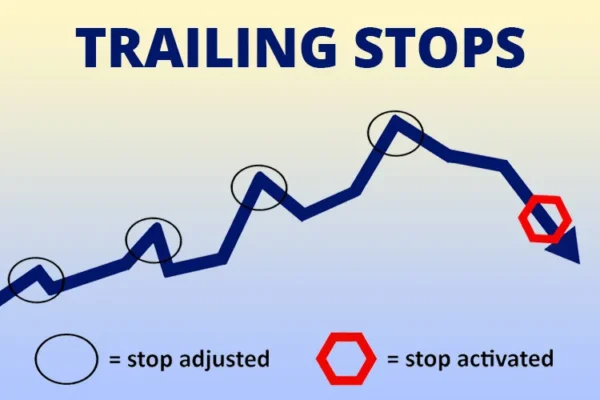
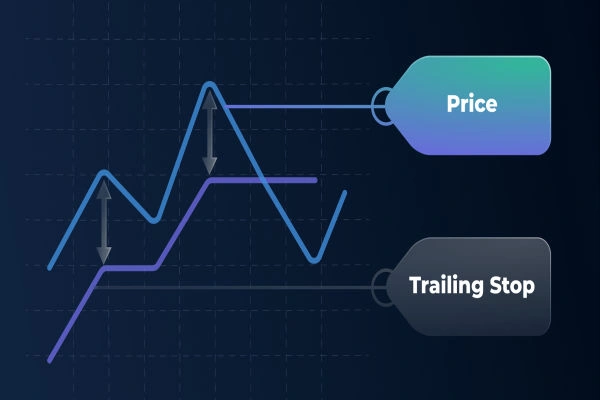
A trailing stop loss is a type of sell order that automatically adjusts with the stock’s moving value. Most importantly, the stop loss order moves up with the stock’s value after it has increased. For example:
- You buy a stock at $25.
- The stock’s value rises to $27.
- You place a trailing stop loss order using a $1 trailing value.
- As the price moves upward, the stop price remains $1 below the current price.
- The stock price reaches $29 and then begins to fall. The last stop loss will be $28.
- When the stock price hits $28, your stop loss order converts to a market order. This means you sell the stock. At this point, your profits are locked in (assuming a buyer can be found).

Identifying Traditional Stop Loss
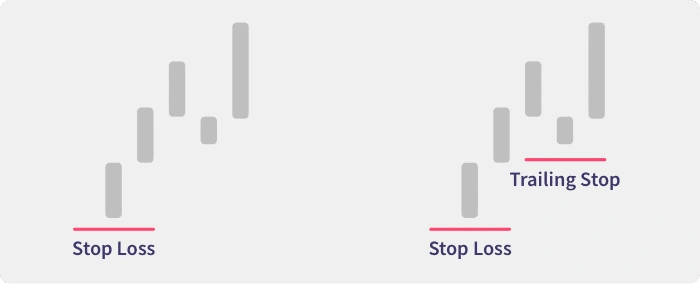
A traditional stop loss is an order automatically designed to limit losses. Unlike a trailing stop loss order, it does not track or adjust with the stock’s changing price.
A traditional stop loss order is placed at a specific price point and does not change. For instance:
- You buy a stock at $30.
- You set your traditional stop loss order at $28. In this case, the stock will be sold at $28.
If the stock price increases to $35 and then suddenly drops, you will still sell at $28. You will not protect the paper profits you have gained from the recent rise in the stock.
How to Use Trailing Stop Loss?
A trailing stop follows price movements in real-time and stops when the market trend changes. The operation is essentially as follows:
- In a long position, the trailing stop increases in line with the market and stops when the price falls. When the price drops to the set level, the position will automatically close.
- In a short position, the trailing stop follows the downward price movement and freezes when the price increases. When the price reaches the set level, the position will automatically close.
A stop loss is only activated when it encounters the price. At that time, the operation will be closed with profits.
Trailing Stop Loss Examples
Let’s look at an example of how to use a stop loss in Forex to help us understand how it works.
Buy Order
Suppose we open a buy order at 1.11300 and set our trailing stop 30 pips below that price (1.11000). If the market moves in our favor, and EURUSD rises to, say, 1.11700, our stop will trail the price up to 1.11400. If at that moment, the market turns, and EURUSD drops, the trailing stop will freeze at its last value, activating when the price reaches 1.11040. This would allow us to secure a 10-pip profit (the order opened at 1.11300 and closed at 1.11400).
Sell Order
Now let’s consider an example of a sell order with the same pair. We open the order at 1.11800 and set the trailing stop at 30 pips, in this case at 1.12100. If the price moves in our favor, the trailing stop will follow it, always maintaining the 30-pip distance. If, on the contrary, EURUSD increases against our position, it will activate at the last level it reached when the market was in our favor.
If you’re wondering which level is best to place a trailing stop, it’s advisable to place it at the last major or local support or resistance level of the price.
Difference Between Stop Loss and Trailing Stop
We must not confuse a stop loss order with a trailing stop order, as their functions differ.
While we can confirm that a trailing stop is a type of stop loss order, it should be clear to us that a trailing stop is used to secure potential profits when the market moves in our favor, whereas a stop loss is used to limit losses if the market moves against us.
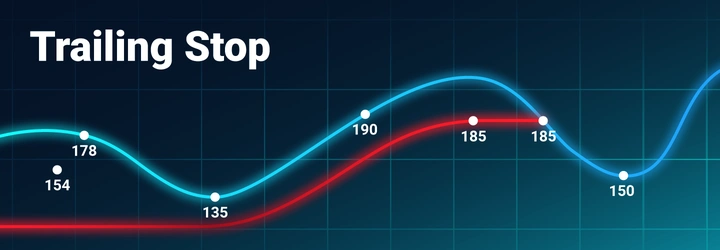
The primary difference between a stop loss and a trailing stop is that a trailing stop moves with the price whenever it moves in our favor and freezes when it moves against us.
On the other hand, a stop loss always remains fixed at the level we set, regardless of the asset’s movement, and is triggered when the price reaches that level.
A trailing stop should never be less than a stop loss.
When Should We Use Trailing Stop Loss?
They only commence during the standard market session, from 9:30 a.m. to 4 p.m. ET. They are not activated or directed for execution during extended sessions, such as pre-market or after-hours sessions, or when a stock is not trading (e.g., during a stock halt or on weekends or market holidays). You can decide how long your trailing stop will be effective; whether it is set to remain in effect only for the current market session or for future market sessions as well.
What are the Risks of Trailing Stop Orders?
Trailing stop orders submit a market order upon activation and typically offer execution. Managing a position in trading is essential, and understanding the risks you face when using trailing stops is important.
- Stock Splits: Initiating a trailing stop order relies on market data from third parties. Your order may be settled prematurely due to stock splits, symbol changes, price adjustments, and/or inaccurate or out-of-market values provided by one of the third parties.
- Gaps: Trailing stops are vulnerable to price gaps, which can sometimes occur between trading sessions or during trading halts. The execution price could be higher or lower than the trailing stop’s end value. The trailing stop merely indicates at what price you want a market order to be submitted.
- Market Closures: Trailing stops can only be activated during a regular market session. If the market is closed for any reason, trailing stops will not be executed until the market reopens.
- Fast Markets: The speed at which prices move can also affect the execution price. When the market is volatile, especially during periods of high trading volume, the price at which your order is executed may not be the price you saw when you submitted the order for execution.
- Liquidity: You may receive different prices for portions of your order, especially for orders involving a large number of shares.
- No Market Exists: If there is no market for the stock (meaning no bid or ask is available), or if the stock itself is not open for trading, the market order generated by your trailing stop cannot be executed.
How Can Market Psychology Help My Next Trailing Stop?
During a momentary price decline, it is crucial to resist the urge to reset your trailing stop, otherwise, your effective stop loss may end up being lower than anticipated. Similarly, when you see that the movement in the charts is peaking, especially when the stock reaches its highest point, restraining subsequent stop losses is advisable.
Why Should We Use Trailing Stop?
Traders and investors can enhance the effectiveness of a stop loss by pairing it with a trailing stop, where the stop loss price is not fixed at an absolute dollar amount but is set at a specified percentage or dollar amount below the current market price, which is continuously revised as the market moves upward (for a buy position). Trailing stops may be used for stocks, options, and futures that support traditional stop loss orders.
Final Word
Trailing means converting momentary profit into stable profit—the moment the trader distances themselves from emotional behavior and makes a logical decision with mental discipline and emotional control. In reality, trailing is not just a technical tool for moving the stop loss but is considered a professional approach to managing profit and risk.
By employing a trailing stop, the trader allows the market to move to whatever extent it wishes, while simultaneously preventing price reversals and profit erosion by gradually moving the stop loss. This approach is a combination of patience, discipline, and a deep understanding of market structure—a method that aligns with the market’s flow rather than fighting against its fluctuations. Ultimately, trailing is a symbol of a trader’s intellectual maturity—a method that gives meaning to survival, growth, and self-mastery on the path of trading.
Similar articles you need to read:
Predicting the Future Price of Bitcoin with AI ChatGPT
Forex Trading Tutorial with Minimum Capital + Start with $100